A Fated Feast
Bound by a divine decree, a Man lays chained to a mountain as an Eagle feasts upon his flesh. But when the Eagle glimpses a vision of cosmic ruin, it becomes torn between instinct and revelation.
Above the jagged, snow-capped peaks of the Caucasus, a giant Eagle soars like a god surveying its creation. A mighty bird of wisdom, cunning, and strength. Its broad wings slice through the thin mountain air as it circles an outcropping of rocks, isolated against the tallest peak. A peak so high that it pierces the clouds and hides from the flat land below. A desolate island floating atop the world.
Hunger threatens the Eagle. A gnawing pain grows within, one that can only be cured by sinking its long talons and speared beak into flesh, to devour the muscle and ligaments of any creature, regardless of stature. The pain of hunger is in the Eagle but not of the Eagle.
A white light shines against the dull gray of the rocks below, catching the Eagle’s eye as it circles above. Curious, it swoops down and lands on the outcropping.
Lying on his back and shackled to the mountain is a large, naked, chiseled Man. A prisoner of some kind. Despite exposure to the extreme sun and ice-capped peak, his skin remains pristine. The source of the white light is revealed. The Man is a giant, as if cut from pure marble. His massive frame rises and falls with slow, steady breaths.
At first, the Man does not notice the Eagle. He stares at the sky. The Eagle, driven by both hunger and curiosity, hops closer, its sharp eyes surveying the Man’s perfect body, searching for a place to strike, for a cure to a haunting primal urge.
A long shadow crosses the Man’s eyes, pulling his gaze away from the sky. His eyes meet the Eagle’s, and for a moment, neither blinks.
Beast and Man.
The Eagle hops forward again, its craving intensifying. Still locked in the Man’s stare, it bows its head. A final, solemn warning, nature’s last kindness before the inevitable strike. A prayer for the dying.
The Man releases his gaze, tilts his head back, and stares once more at the sky.
“Do as you’re told,” he murmurs, his voice void of care or resistance.
With those words, the Eagle attacks. Its talons stab and rip through the Man’s unblemished skin, tearing deep in search of flesh. Shards of skin land on the rocky outcropping, and blood splatters across the stone. The Eagle’s white-feathered head turns dark red, its eyes barely visible beneath the gore.
With an opening into the Man’s ribs, the Eagle drives its beak in, stabbing and pulling at the sinew. It pecks and tugs at cartilage, stripping away strands of muscle. The Eagle devours the flesh, its hunger overtaking reason. Euphoria washes over the Eagle as it tears and feasts, driven only by the incessant, deep-rooted need to eat.
The Man exhales. Unbothered. His voice is inaudible beneath the sound of flesh snapping from bone.
The Eagle pauses, a string of gristle dangling from its beak. All the eating has forced it to take a breath, to let the Man’s flesh settle inside its stomach.
The Man doesn’t acknowledge the Eagle and mumbles again, speaking to no one.
Curious, the Eagle hops onto a nearby branch, just beyond the Man’s reach. It does not understand the Man’s words, nor the meaning behind them. Sounds without meaning. The Eagle only understands the language of hunger, survival, and instinct.
Yet the Man’s inaction unsettles the bird. He did not scream or struggle, as all other prey do when they are eaten alive. He did not beg for mercy. Instead, he remains still, shackled to the rock, resigned to a fate only one being can justify.
The Eagle tilts its head, confused. Its eyes scan the Man’s body, taking stock of its work. Torn flesh litters the rocky outcropping. Blood stains the ground in pools. But something is wrong.
Before the Eagle’s eyes, the ragged gashes in the Man’s body begin to mend. Sinew re-knits itself. Blood evaporates and vanishes. The Eagle has never seen such a spectacle. It expected the flesh to rot, not regenerate.
The Man, weary, turns to the bird and meets its gaze once more. “At least I can see the chains that bind me to this scene.”
The Eagle cocks its head. More words. More language. No meaning. Confused, the Eagle hops away from the Man. Its hunger is satisfied. The instinct to kill, to survive, is gone. A gust of wind rustles the bird’s feathers and lifts it into the air.
The next day, the Eagle wakes to the same gnawing pain of hunger. Without thought, it takes flight toward the outcropping. The same routine: wake, take flight, hunt, eat, sleep.
The Man lies on the ground as before. Naked. Chained. Untouched. As though the previous day had never happened. The Eagle only sees opportunity. The thought of yesterday never crosses its mind, for a thought can kill an instinct, and instinct is what is needed for survival.
The Eagle lands beside the Man. It surveys the immaculate body laid out before it. Hunger and desire inflamed inside the Eagle. It prepares for a feast.
Again, their eyes meet. No words are spoken.
But a new sensation crawls through the Eagle’s body. From a place beyond hunger, the Man’s voice echoes in its mind: At least I can see the chains that bind me. A voice unwelcome. A thought unknown.
Sorrow?
Guilt?
The Eagle flinches, unsure of this strange weight in its chest. The hunger still gnaws, but a feeling unfelt before this moment grips tighter.
A sudden scream shatters the silence.
The Eagle recoils, startled. The Man unleashes a furious cry, his voice a tempest of rage and agony. The mountain shakes. Snow and rock cascade from the mighty peaks. The scream reverberates through the Eagle’s bones, its flesh, its mind.
“Bring me my torch,” the Man commands, pointing near the ledge of the outcropping. “Free me from these shackles. From this envy. From this disgrace.”
The Eagle shifts its gaze. Just beyond the Man’s reach, a small thicket torch flickers. The flame is fragile yet eternal.
“I command you, bird,” the Man roars, “bring me my fire!”
A tremor ripples through the Eagle, forcing it forward. It tries to change course, to fly away, but it is caught by a force beyond control. Closer and closer, the Eagle hops. It tries to turn away, but it cannot. As its beak brushes the torch, a bolt of lightning cleaves the sky and strikes the Eagle.
Pain. White-hot. All-consuming.
The Eagle convulses. Its muscles lock. Its heart stops mid-beat. And in that moment, it sees everything.
The past. The future. All of existence at once: The sky burns. A war rages beyond sight, beyond reason. Two titans clash against each other. Giant balls of fire strike against an endless form of earth and ocean, and in their struggle, the world is shaped. The fight is eternal. The victor is known. The fate of all things already written.
The Eagle spreads its wings and, with a sudden thrust, shoots toward the heavens, piercing the storm clouds, flying into a blue sky untouched by suffering.
A single choice remains.
It plummets.
Lightning streaks around its wings as it falls like a spear toward the earth.
And into the Man’s chest.
The Man screams. The sky is still.
And from that moment on, the Eagle has but one thought.
One desire.
For all eternity.
To consume the flesh of the shackled Man.
Author’s Note
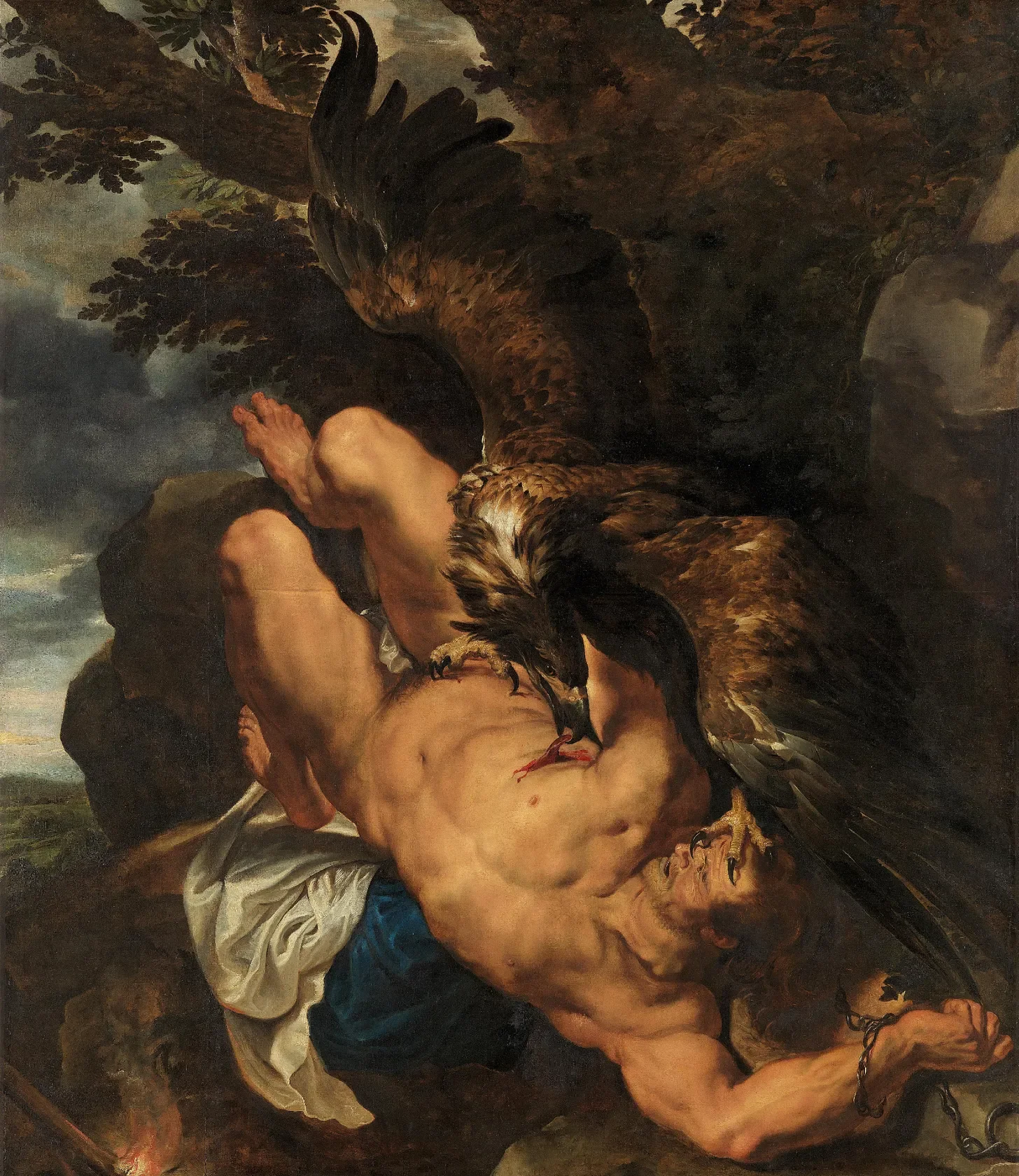
Prometheus Bound
Begun c. 1611-1612, completed by 1618.
Peter Paul Rubens (Flemish (active Italy, Antwerp, and England), 1577–1640) , and Frans Snyders (Flemish (active Antwerp), 1579–1657)
“A Fated Feast” is inspired by Prometheus Bound (1611–1618), a painting by Peter Paul Rubens and Frans Snyders, which captures the brutal torment of Prometheus as Zeus’ eagle relentlessly devours his regenerating flesh.
While the painting focuses on Prometheus’ suffering, this story shifts the perspective to the Eagle, transforming it from a mindless enforcer of divine will into a being capable of self-awareness, doubt, and existential horror.
Through this lens, “A Fated Feast” explores fate, free will, and the nature of oppression and explores the idea that Prometheus is not the only prisoner of the gods.
Prometheus Bound is a beautiful depiction of suffering and contrasts the idealized, powerful body of Prometheus with the brutal reality of divine punishment. The raw, almost predatory energy of the Eagle is painted in exquisite detail and emphasizes the relentless nature of his torment. This story seeks to expand upon the themes in Rubens’ painting while adding a new perspective:
Who else suffers in this eternal cycle?
Is the enforcer of pain just as trapped as the victim?
If given the chance to break free, would it even be possible?
By centering the Eagle’s perspective, “A Fated Feast” reinterprets the myth as a tragedy of realization and futility. In the end, the Eagle, like Prometheus, is bound by forces beyond its control. The retelling reveals that divine punishment extends not just to rebels, but to those who carry out the will of the gods.