Dust, Ditches, and Clean Verbs: Model Sentences from John Steinbeck
Sentences to study and imitate from the author of East of Eden, The Grapes of Wrath, and The Winter of Our Discontent, quotes about writing and purpose, and Steinbeck’s Nobel Prize Speech.
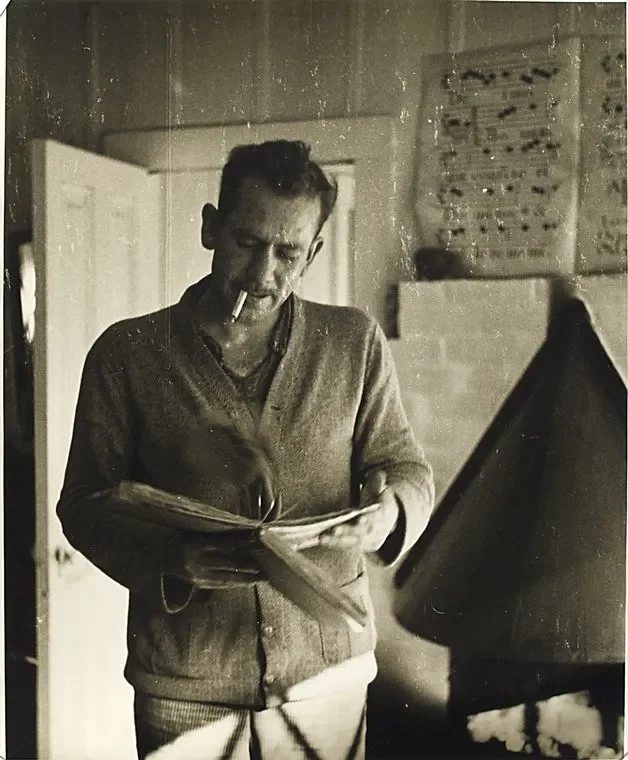
Photo by Peter Stackpole
A writer of the common man and the farm worker, John Steinbeck’s novels and stories express the dreams, desires, and hardships faced by everyday people trying to eke out a living. His writing is descriptive, oddly prophetic, and sorrowful. Studying the words and style of John Steinbeck offers a unique glimpse into an artist who was both in tune with the hardships of everyday life while expressing the innate drive to survive inside us all.
Three Questions to Ask When Studying Sentences
Use these three guiding questions to help you study the model sentences below and to write your own:
How is the sentence structured, and why does that structure work?
What literary or rhetorical devices are being used, and how do they enhance the sentence?
How does the sentence create emotion, and what techniques contribute to that effect?
Three Sentences by John Steinbeck to Study and Imitate
Sentence #1
“All great and precious things are lonely.”
Practice: Try this sentence frame using a topic from your writing.
All _____ and _____ is/are _____.
Here’s an example I came up with.
All boring and mundane routines are necessary for success.
Sentence #2
“Death was a friend, and sleep was Death’s brother.”
Practice: Try this sentence frame using a topic from your writing.
_____ is/was a _____, and _____ is.was _____.
Here’s an example I came up with.
Love is a stranger, and Obsession is Love’s only friend.
Sentence #3
“We can shoot rockets into space but we can’t cure anger or discontent.”
Practice: Try this sentence frame using a topic from your writing.
(Pronoun) can _____ but (Pronoun) can’t _____ or _____.
Here’s an example I came up with.
He can successfully restructure a Fortune 500 company in a matter of weeks but he can’t remember to buy a present for his son’s birthday or send flowers to his wife for their anniversary
Your Turn: Use the model sentences and frames to craft your own sentences and post them in the comment section below.
Two Quotes by John Steinbeck on writing and purpose
Quote #1
“The writer must believe that what he is doing is the most important thing in the world. And he must hold to this illusion even when he knows it is not true.”
Journal Prompt: To what extent do you agree or disagree with Steinbeck? Why hold this illusion of importance?
Quote #2
“Write freely and as rapidly as possible and throw the whole thing on paper. Never correct or rewrite until the whole thing is down. Rewriting in process is usually found to be an excuse for not going on.”
Journal Prompt: Rewriting in process could be described as an act of Resistance. What other aspects of your process must you protect in order to combat against Resistance?
One Cool Thing - John Steinbeck’s Nobel Prize Speech
In 1962 John Steinbeck won the Nobel Prize in Literature "for his realistic and imaginative writings, combining sympathetic humor and keen social perception." It was Steinbeck’s 11th nomination - his first was in 1943. At the time the Nobel committee was criticized for their selection of Steinbeck. And the Nobel archives show that Steinbeck wasn’t the committee’s desired choice. When Steinbeck was asked if he felt he should receive the award he answered, “Frankly, no.”
My favorite part of the speech is when Steinbeck seemingly foreshadows our current social climate when he writes of a “universal fear” because of “a forward surge in our knowledge and manipulation of certain dangerous factors in the physical world.” Steinbeck was writing at a time when technological advancements were propelling society forward quicker than human understanding could comprehend. We were becoming gods as Steinbeck would later state in the speech. The choice for the future was ours. Steinbeck believed it would be the “writer’s responsibility” to help society usher forward with a reverence for nature and peace.
Help Spread the Word
If you found this writing lesson helpful, here are three ways you can help:
Leave a comment below about what you like and any tips for making it more helpful.
Share this writing lesson with a friend who wants to improve their writing.
Click on the Subscribe button.