Ask the Stars: What Makes “The Night Came Slowly” by Kate Chopin Great?
Let's take a look at how Chopin uses personification to bring nature to life, how she uses imagery to develop the story's mood, and how she use tone to create emotional depth.
Photo by Terry Sieting on Unsplash
The night is when the writer comes out to play.
There’s a distinct kind of stillness that descends on a writer late at night, the kind where distractions fade, and the world feels suspended in time. It’s in these moments, staring out at a darkened sky or hearing the rustle of leaves, that I’ve often found myself reading, studying, and thinking about stories like Kate Chopin’s “The Night Came Slowly.”
Chopin’s brief (it’s about 500 words) yet profound story reminds me why I write: to capture fleeting feelings, to explore the tensions between humanity and solitude, and to seek meaning in the smallest moments.
Chopin, known for her nuanced portrayals of women’s inner lives and their complex relationships with society, delivers a deeply introspective and atmospheric story in “The Night Came Slowly.”
As always, before reading on I suggest you take a few minutes to read the story. It’s a very short story, and I’m confident you’ll be amazed by how impactful and poetic it is. HERE is a link to a PDF of the story.
So…what’s the story about?
The story focuses on a narrator who, disillusioned with humanity, finds solace in the quiet, mysterious beauty of the natural world. Through her musings, the story explores themes of alienation, the search for meaning, and the healing power of nature. It shows how solitude can provide clarity, how nature can soothe an aching soul, and how even a fleeting night can carry profound emotional weight.
The story’s strength lies in its beautiful use of three specific techniques: personification, imagery, and tone. Together, these elements create a vivid, emotionally deep experience that invites readers to slow down and connect with the narrator’s world.
As writers, we can study Chopin’s approach to see how she uses these tools to craft a story that lingers in the mind long after it’s read.
To guide the analysis, let’s frame our discussion using the following questions:
How does Chopin use personification to bring nature to life and develop the theme(s)?
How does Chopin use imagery to create the mood of the story?
How does Chopin use tone to enhance the emotions of the story?
Let’s cut to the chase and get to the charts, shall we?
How does Chopin use personification to bring nature to life and develop the theme(s)?
Personification is one of the most striking techniques in Chopin’s story. Nature becomes a living, breathing character. By assigning human qualities to elements like the night, wind, and stars, Chopin creates an intimate connection between the narrator and her environment.
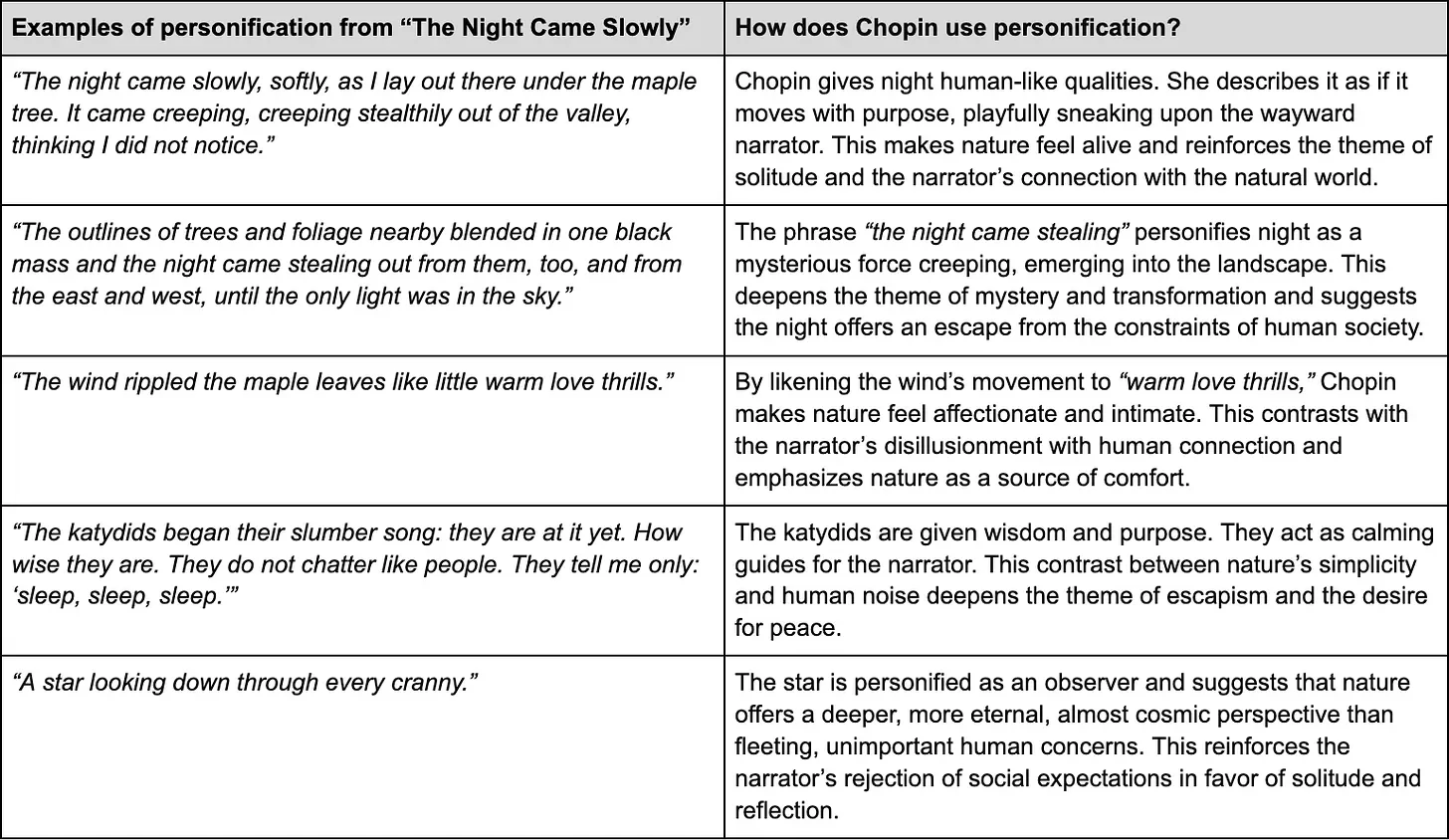
Through these moments, Chopin transforms the natural world into a source of companionship and comfort. Chopin’s use of personification supports the story’s theme by emphasizing the narrator’s connection to nature as a refuge from the chaos of human interaction. Readers can’t help but feel the narrator’s longing for something greater than the fleeting and disappointing experiences of human interaction.
A few ideas to consider:
Give nature purpose, intention and emotion - Instead of describing the setting, allow elements of nature to “act” or “behave” with purpose.
Example: Rather than saying “the wind blew through the trees,” try “the wind whispered secrets through the trees, urging them to dance.”
Use personification to reflect a character’s emotions - Let the environment mirror or contrast the protagonist’s state of mind.
Example: If a character feels lonely, describe the moon as “a watchful eye in the dark” or if they are feeling restless, “the river churned in quiet frustration.”
Make the natural world feel like a character - Treat nature as an active force with its own personality—gentle, menacing, comforting, or mysterious.
Example: “The night crept forward, wrapping the town in its inky embrace.” This makes night feel alive and purposeful.
Use personification to create mood - Soft, comforting personification can create a peaceful mood, while eerie or aggressive personification can build tension.
Example: “The storm roared its discontent, slamming rain against the windows,” vs. “The morning sun stretched its golden arms, warming the quiet streets.”
Contrast a personified depiction of nature with human behavior - Highlight how nature acts in contrast to people’s flaws, wisdom, or ignorance.
Example: Chopin’s katydids “do not chatter like people”—they are calm and wise, unlike the intrusive human world.
Use personification to reinforce themes - If your story explores solitude and loneliness, have the night “gently press its silence” around the character. If the theme is transformation, describe dawn as “peeling back the night, layer by layer, revealing the world anew.”
As writers, we can use personification to deepen emotional resonance in our stories. By animating the setting, we invite readers to experience it as vividly as the characters do, building a bridge between their emotions and the story’s world.
How does Chopin use imagery to create the mood of the story?
Chopin’s lush, sensory descriptions pull the reader into the narrator’s world and makes the night come alive. Imagery is an essential device used in the story to create a setting that feels both serene and mysterious.
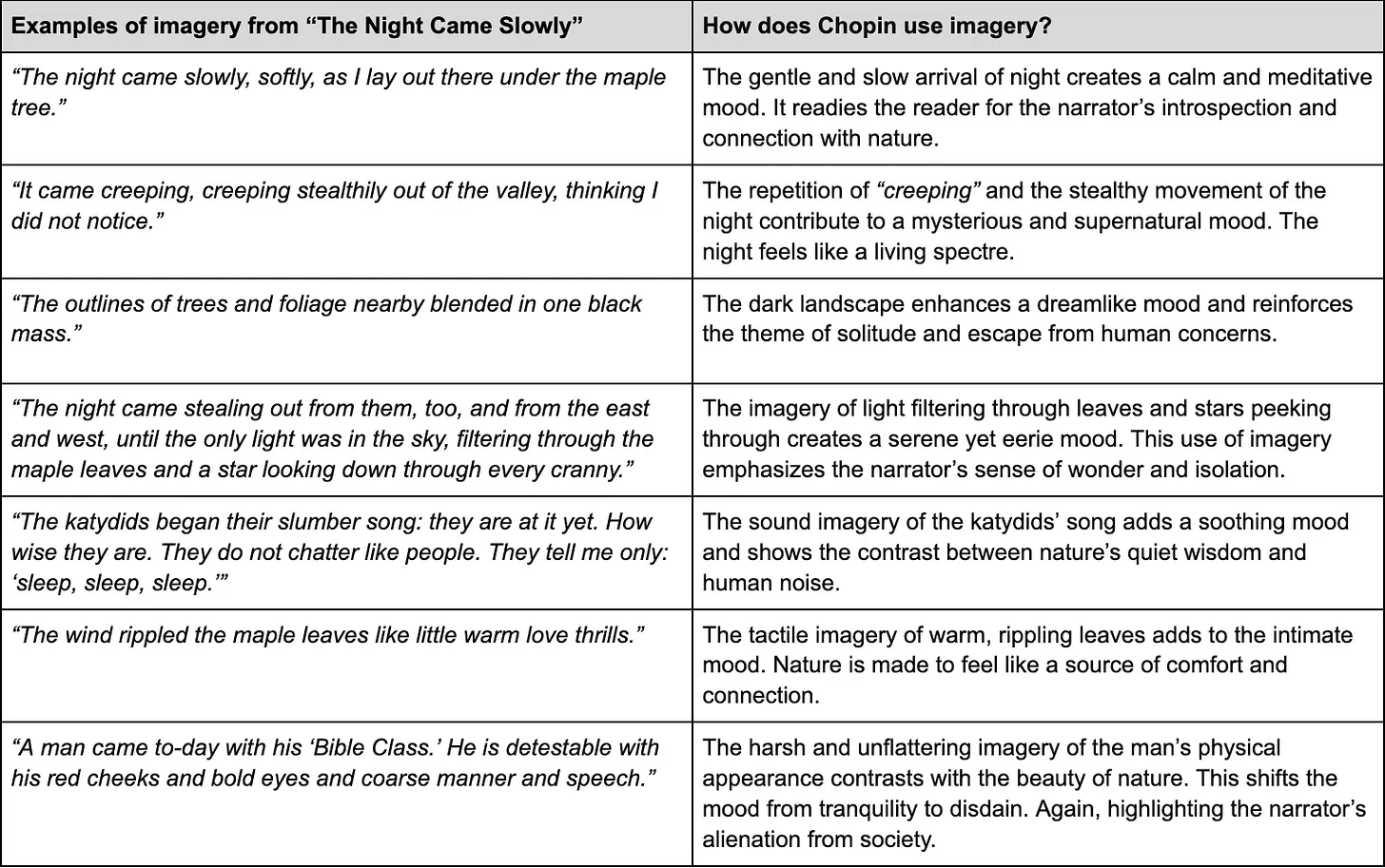
These descriptions layer the setting with texture and mood. The imagery not only paints a vivid picture but also mirrors the narrator’s emotional state—calm, reflective, and yearning for connection. Each sensory detail draws the reader deeper into the narrator’s world, creating a shared sense of solace and wonder.
A few ideas to consider:
Use sensory details to create mood - Chopin’s descriptions of the night (“creeping, creeping stealthily”) establish a mysterious, meditative mood. Writers could choose words that evoke specific emotions—e.g., dark, whispering forests for suspense or golden, sun-drenched fields for warmth.
Blend setting with character emotions - The narrator’s growing detachment from humanity is reflected in the imagery of nature surrounding her. Writers can mirror a character’s inner world through descriptions of their surroundings, making the setting an extension of their emotional state.
Show change through shifting imagery - As night fully takes over, the world transforms (“blended in one black mass”). Writers can use evolving imagery to reflect changes in time, mood, or character development—e.g., a bright morning turning into a stormy afternoon paralleling rising conflict.
Contrast nature with human-made elements - Chopin’s contrast between peaceful nature and the harsh, unattractive description of the Bible class teacher emphasizes the theme of alienation. Writers can use contrasting imagery (e.g., a noisy, polluted city vs. a quiet, open field) to highlight conflict between opposing forces.
Use repetition and rhythm to make imagery immersive - The repeated “creeping, creeping” in the story mimics the slow movement of the night, drawing the reader into the experience. Writers can use rhythm, repetition, or alliteration to reinforce mood and motion.
Personify elements of nature to create intimacy - Chopin gives the night agency (“thinking I did not notice”), making it feel alive. Writers can give nature or objects human-like qualities to make their worlds feel more dynamic and emotionally resonant.
Use specific and unexpected comparisons - The wind rippling the maple leaves like “little warm love thrills” is a unique and sensual description. Writers should aim for fresh, evocative metaphors and similes rather than common ones to make their imagery more impactful.
For writers, imagery is a powerful tool for drawing readers into a scene. By engaging the senses, we can evoke emotions and build an atmosphere that stays with the reader and make the story more vivid and memorable.
How does Chopin use tone to enhance the emotions of the story?
The reflective and somewhat bitter tone of “The Night Came Slowly” sets the emotional foundation of the story. Chopin’s narrator speaks with a mix of quietness and frustration. The narrator has a voice that is both contemplative and raw.
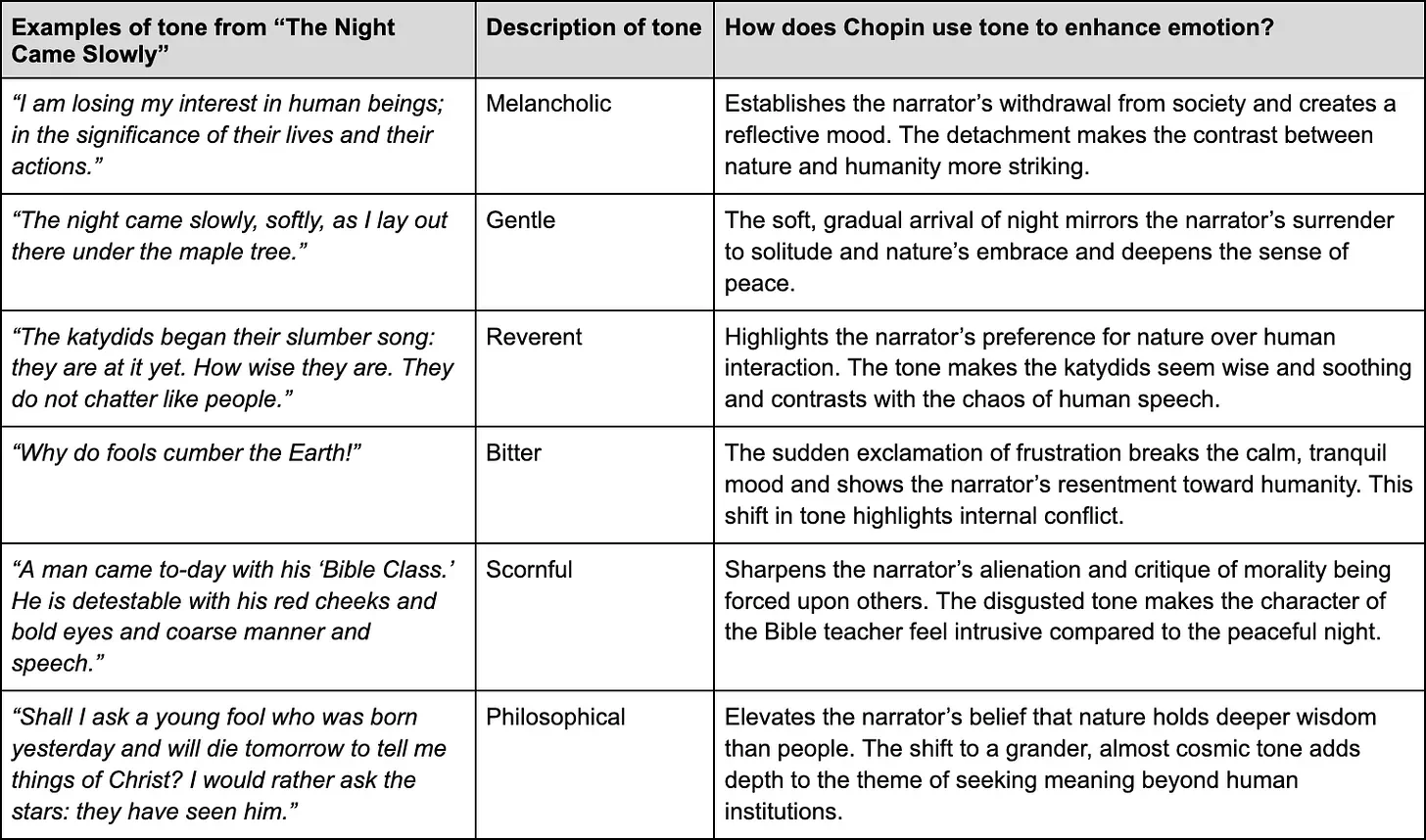
Chopin’s use of tone enhances and illuminates the theme of alienation by making the narrator’s retreat into nature feel both poignant and inevitable. Her disconnection from humanity and connection to the natural world are brought to life through her reflections and allows readers to feel her emotional struggles as if they were their own.
A few ideas to consider:
Make sure tone aligns with characters’ emotions - Chopin’s shifting tone mirrors the narrator’s emotional journey—from detachment to reverence to frustration.
Tip for writers: Adjust the tone as your character’s emotions evolve to create a dynamic, immersive experience.
Contrast tones for emotional impact - The peaceful, poetic descriptions of nature contrast with the harsh, bitter tone used for humans.
Tip for writers: Use tone shifts to emphasize contrasts—such as hope vs. despair, beauty vs. ugliness, or solitude vs. intrusion.
Use tone to reinforce theme(s) - Chopin’s tone reinforces the theme of nature’s wisdom vs. human stupidity.
Tip for writers: Let your tone reflect the deeper meaning of your story. Ask: What emotion best conveys my theme?
Let word choice and syntax shape tone - Chopin’s word choices—“stealing,” “caressing,” “detestable”—intensify tone. Her use of syntax moves between flowing and abrupt to reflect mood.
Tip for writers: Experiment with descriptive vs. blunt language and long vs. short sentences to sharpen your story’s tone.
Maintain a consistent tone or deliberately shift tone throughout - While Chopin shifts tone, the overall mood remains cohesive—meditative and melancholic.
Tip for writers: Avoid jarring, unintentional tone shifts unless they serve a purpose. Be mindful of how tone is used throughout the story.
Writers can use tone to guide readers through a story’s emotional landscape. By carefully choosing words and sentence rhythms, we can craft a voice that resonates with the audience and aligns with the story’s theme, creating a powerful emotional impact.
Your Turn: Readers & Writers Workshop
Tool for Readers: Imagery Mapping Exercise
Goal: Readers will see how sensory details contribute to the emotional impact and theme(s) of the story.
How It Works:
Select a passage or short story – Choose a section rich in imagery (e.g., The Night Came Slowly by Kate Chopin).
Create an Imagery Map – Use a graphic organizer to categorize and analyze the imagery by sense (sight, sound, touch, taste, smell).
Identify Mood & Theme Connections – Reflect on how the imagery shapes the story’s mood and contributes to its themes.
Synthesize Patterns – Identify dominant patterns (e.g., dark vs. light, movement vs. stillness) and discuss how they reinforce the narrative’s emotional impact.
Example Application using “The Night Came Slowly”
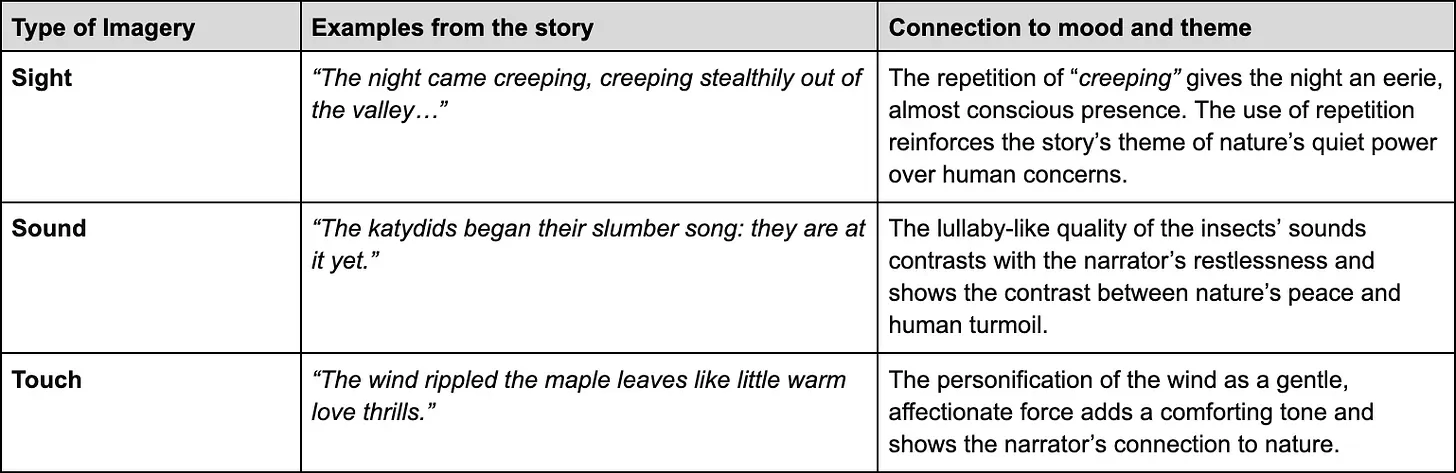
Tool for Writers: The Tone Shift Experiment (for practice and for revising a work-in-progress)
Goal: Writers learn how subtle shifts in language shape a reader’s emotional response to the story.
How It Works:
For practice:
Start with a short, neutral scene (or use a prompt).
Rewrite the scene in at least three different tones (e.g., melancholic, hopeful, suspenseful).
Compare the versions to see how changes in word choice, sentence structure, and imagery influence emotional impact.
Example:
Neutral: The night came, and the wind moved through the trees.
Melancholic: The night sank over the land, the wind sighing through the trees like a weary traveler.
Ominous: The night crawled in, shadows twisting as the wind whispered secrets through the trees.
Hopeful: The night unfurled softly, the wind carrying the scent of blooming jasmine through the trees.
As a tool for revision:
Select a passage from a work-in-progress where tone could be stronger or more intentional.
Rewrite the passage in 2-3 different tones.
Read each version aloud and analyze which tone best serves the story’s purpose.
Revise the passage accordingly.
Example:
Original (Neutral): She walked through the empty house, her footsteps echoing in the halls.
Version 1 (Nostalgic): She moved through the house slowly, trailing her fingers over the worn banister, remembering laughter that once filled these halls.
Version 2 (Eerie): She crept through the house, each footstep swallowed by the silence, shadows lurking in the corners.
Version 3 (Melancholic): She wandered the house, the echoes of her footsteps a lonely reminder of all that had been lost.
Writing Prompt to Practice Personification, Imagery, and Tone
Grab a notebook and a flashlight and take a long walk into the night. Sit down near a tree and let your imagination commune with your surroundings. After reading and studying “The Night Came Slowly,” write a short, short scene using the same devices as Chopin.
Think about your favorite character from a book, TV show, movie, etc. Your character has grown weary of people—their noise, their expectations, their shallow words. One evening, they retreat into solitude to find comfort in the quiet of the night. As they sit beneath a tree, on a porch, or by an open window, they begin to sense the world shifting around them. The night is not empty. It is alive, watching, whispering. The wind carries secrets, the stars blink knowingly, and the shadows seem to listen. As they lose themselves in this stillness, their thoughts drift toward something unresolved—a question, a regret, a longing. They do not speak, but the night answers.
Write a story of 1,000 words or less where your character’s solitude deepens their understanding of themselves or the world around them.
Include the following devices in your story.
Personification: Let nature speak. How does the night, the wind, or the stars communicate with your character? Do they offer comfort, challenge them, or reveal something unexpected?
Imagery: Use rich sensory details to immerse the reader in the night’s presence. How does the darkness feel? What sounds, scents, or sensations fill the air?
Tone: Maintain a reflective, melancholic, or mysterious tone to enhance the character’s emotional state.
I created a Google Doc of the prompt for you to use as you wish, click HERE. Make sure to make a copy.
As Night Turns Into Day (Final Thoughts)
When I sat down to read Chopin’s “The Night Came Slowly” I was immediately drawn into the narrator’s world. I felt like I was sitting next to the narrator, listening to and experiencing their inner thoughts and feelings.
I also thought about Hawthorne’s “The Haunted Mind” while reading Chopin. How two incredible writers explore the mind’s relationship to the external world and inner life of a character. And how both writers use language to utter perfection.
Chopin’s “The Night Came Slowly” is a meditative, quiet story that writers should study regularly. It’s a model example of craft and technique at the highest level. As Chopin’s narrator looses her interest in human connection, I found myself being drawn closer to it.
Funny how that works.
Help Spread the Word
If you found this post helpful, here are three ways you can help:
Option #1: Leave a comment below about what you like and any tips for making it more helpful.
Option #2: Click on the Subscribe button.
Option #3: Share this with a friend who writes fiction.